Composite Joint Toughness Enhancement
Overview
This research develops geometry-driven routes to enhance toughness in composite and hybrid bonded joints. Instead of relying only on stronger adhesives or thicker adherends, the work redesigns local architecture so that extrinsic dissipation, crack deflection, and controlled damage progression improve joint performance.
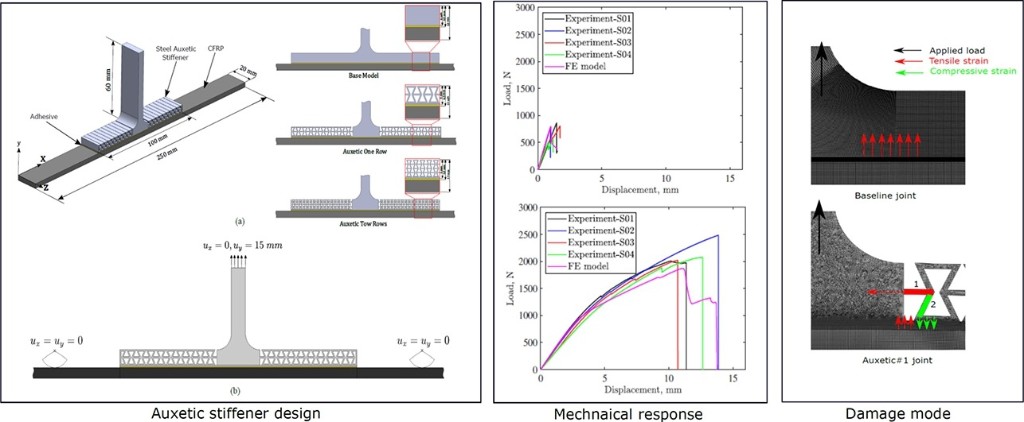
One line of work uses 3D-printed auxetic metal stiffeners in lightweight metal–composite T-joints. The auxetic geometry couples stiffening with a deformation mode that delays catastrophic failure, raising both strength and toughness while keeping the joint light.
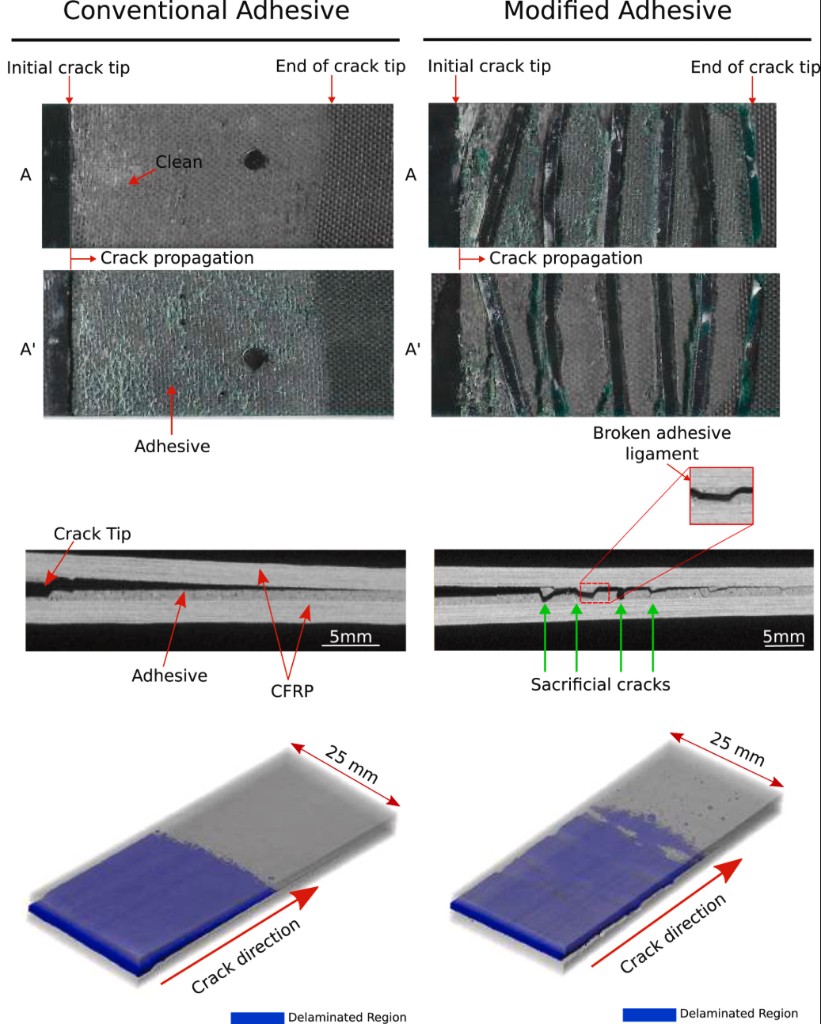
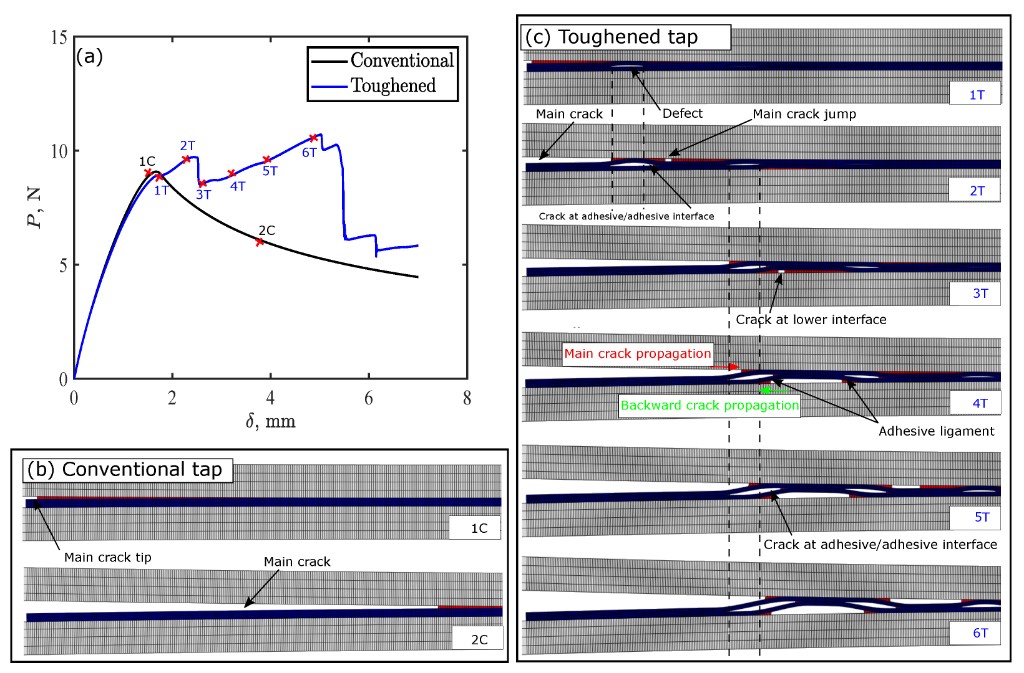
A second line microstructures the adhesive bondline with tailored sacrificial cracks. These intentional defects guide Mode II crack growth, increase energy dissipation, and improve fatigue characteristics of composite bonded joints. Related thermoplastic adhesive tapes use similar microstructuring ideas to create tougher peel and shear response through controlled defects.
More broadly, this theme connects to strategies that harness extrinsic dissipation to toughen composites and composite joints, linking architected interfaces, hybrid laminates, and adhesive design into a consistent mechanics-driven approach for durable bonded structures.
Highlights
- 3D-printed auxetic metal stiffeners for lightweight, high-toughness metal–composite T-joints
- Sacrificial-crack adhesive microstructuring for Mode II toughness and fatigue resistance
- Microstructured thermoplastic adhesive tapes with tailored defects for higher toughness
- Geometry-driven extrinsic dissipation as a design route for durable bonded joints
Figures
Related publications
- 3D Printed Auxetic Metal Stiffener for Lightweight Metal–Composite T-Joints with High Strength and Toughness
- Harnessing Extrinsic Dissipation to Enhance the Toughness of Composites and Composite Joints: A State-of-the-Art Review of Recent Advances
- Mode II Fatigue Characteristics of a Composite Bonded Joint with Microstructured Adhesive Bondline through Tailored Sacrificial Cracks
- Towards Tough Thermoplastic Adhesive Tape by Microstructuring the Tape Using Tailored Defects