Event-Driven and Edge AI for Structural Health Monitoring
Overview
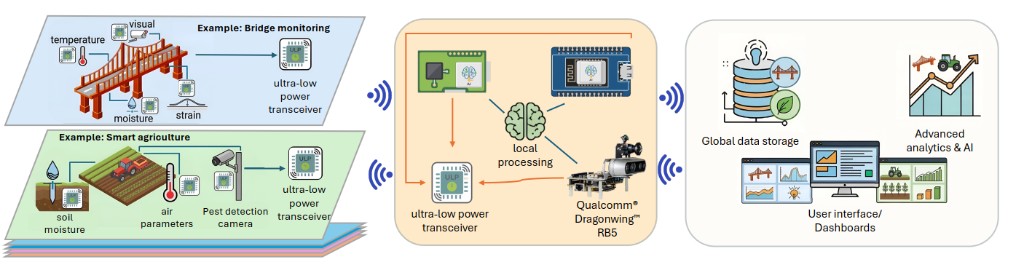
This research theme groups two related but distinct projects that both pursue power-efficient structural health monitoring—reducing continuous sensing, energy use, and network load—while attacking the problem from different layers of the stack.
Together they span vision-triggered edge intelligence and ultra-low-power wireless sensing hardware, and can be combined into an end-to-end pipeline from detection to local sensing to cloud analytics.
Projects under this theme
Complementary projects sit under this umbrella. Each has its own focus and materials below.
Project 1
Semantic Edge AI and Event-Driven Wake-Up Sensing
In collaboration with Omar Khalifa and Ruslan Zhagypar, and under the guidance of Prof. Gilles Lubineau and Prof. Tareq Al-Naffouri, this track uses Qualcomm platforms for event-driven SHM: drone cameras detect cracks via semantic segmentation, and a wake-up transmitter activates local sensors only when anomalies are flagged. A split AI architecture keeps feature extraction at the edge and transmits compact feature tensors instead of raw frames, cutting end-to-end latency by about 56% and saving about 83% bandwidth on Qualcomm RB5 and RB3 Gen2 platforms. Presented and demonstrated at IEEE PIMRC, with related work under review for the IEEE ComSoc Student Competition.


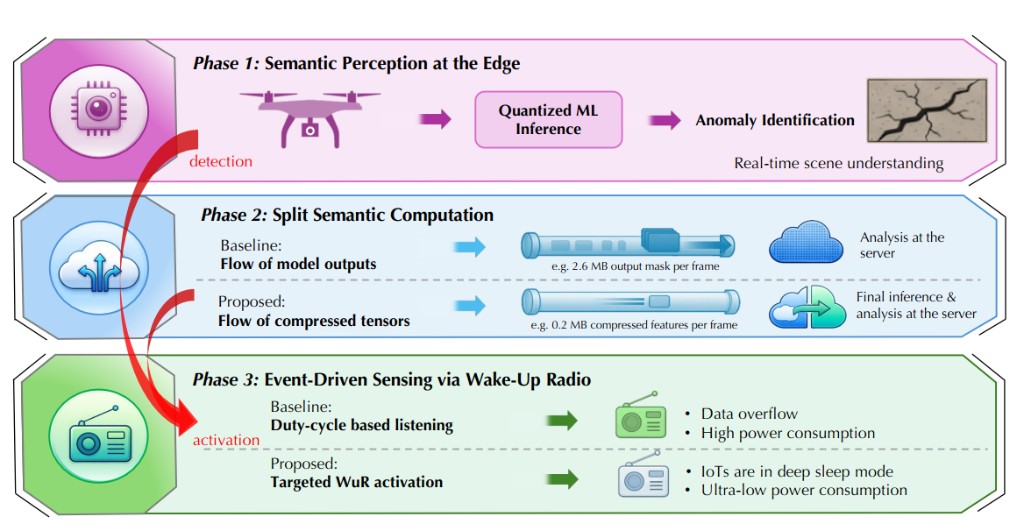
Pipeline for Project 1: semantic perception at the edge, split semantic computation with compressed feature tensors, and event-driven wake-up radio activation of ultra-low-power IoT sensors. Project 2
Hybrid Event-Driven SHM Node with Ultra-Low Power Adaptive Triggering
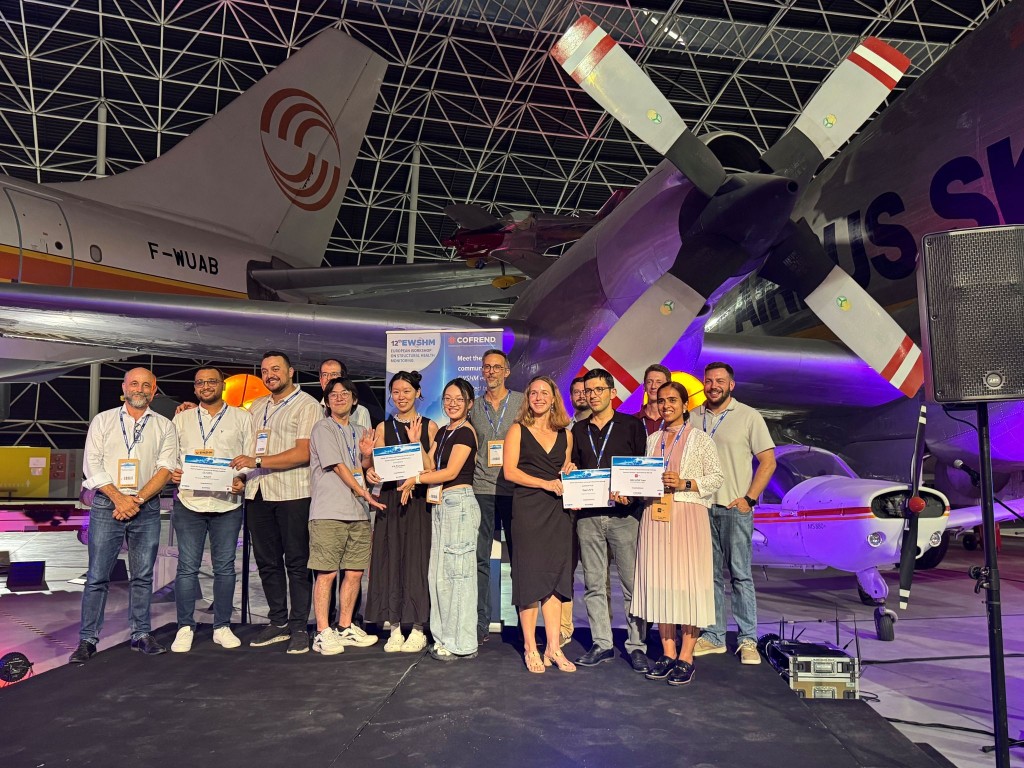
A second project focused on the sensing and radio node itself: a hybrid event-driven structural health monitoring node with ultra-low-power adaptive triggering. The KAUST team developed and demonstrated this system in the EWSHM 2026 Young Professionals Challenge.

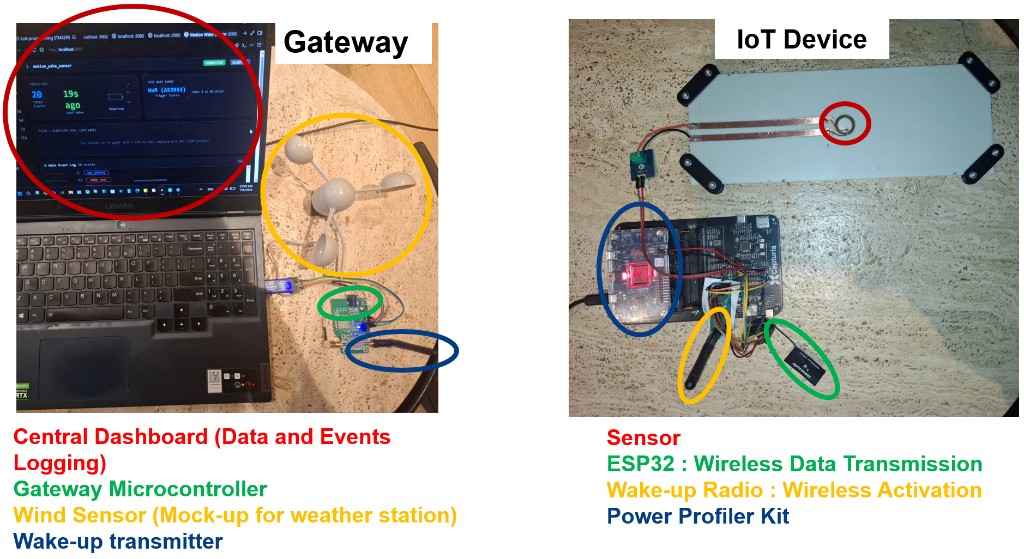
Hybrid event-driven SHM demo setup: gateway (dashboard, microcontroller, wake-up transmitter, wind-sensor mock-up) and IoT device (sensor, ESP32, wake-up radio, power profiler).
Videos
- Track 1 — PIMRC Demo: Event-Driven Edge-AI SHM
- Track 2 — EWSHM 2026 Young Professionals Challenge
Related publications
- When Meaning Controls the Network: Event-Driven Semantic Communication at the Edge
Awards
- EWSHM 2026 Young Professionals Challenge Award