Laser-Induced Graphene Flexible Sensors
Overview
This research develops laser-induced graphene (LIG) as a multifunctional flexible sensing platform in which laser processing sets both the microstructure and the functional response. The same one-shot engraving route supports thermoelectric temperature sensing and highly sensitive strain sensing.
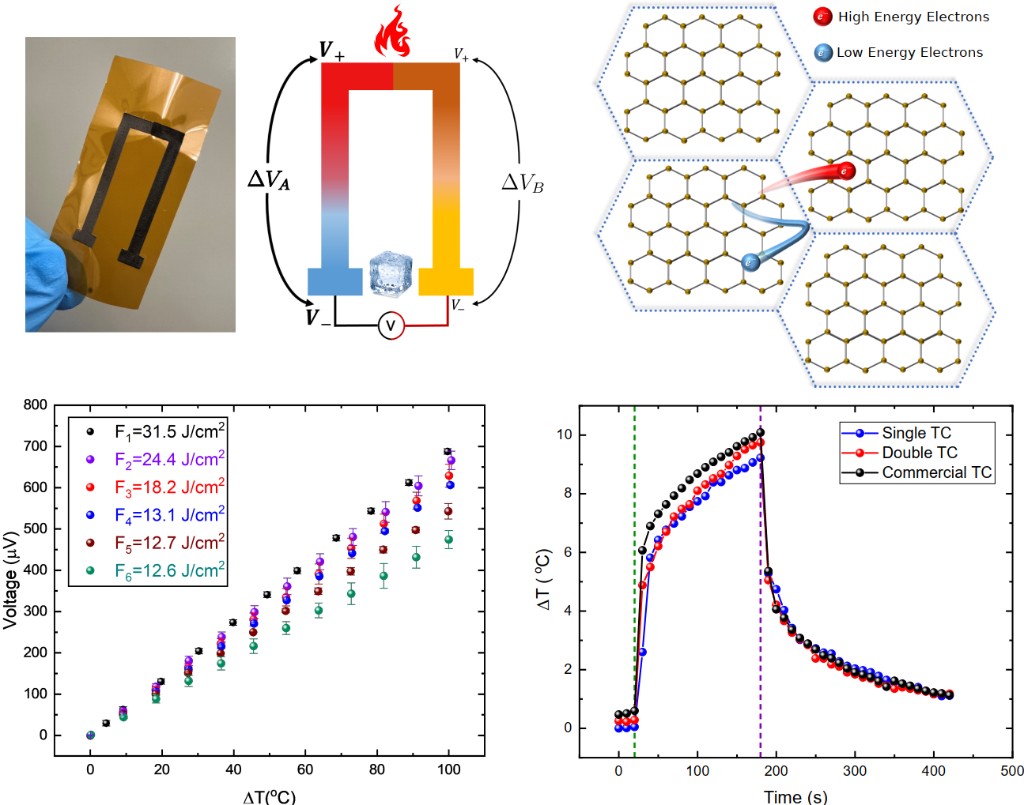
For temperature sensing, processing parameters are used to modulate the Seebeck coefficient of LIG, creating controlled thermoelectric contrast in flexible U-shaped devices. The resulting sensors convert temperature gradients into measurable voltage, enabling lightweight, conformal thermal monitoring without complex multilayer thermoelectric stacks.
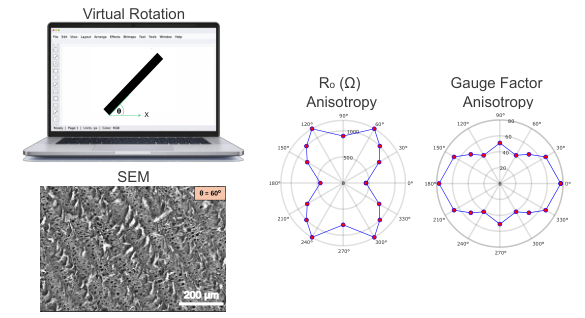
For strain sensing, process-induced electromechanical anisotropy in LIG is leveraged to fabricate highly sensitive piezoresistive sensors in a single laser-engraving step. Aligning the sensing path with the process-defined anisotropy amplifies the resistance change under deformation, yielding sensitive strain readout from a simple, scalable LIG pattern.
Together, these two lines of work show how laser processing can be used as a design tool—not only to write conductive graphene patterns, but to program thermoelectric and electromechanical performance for flexible sensing applications.
Highlights
- Processing-tuned Seebeck contrast in LIG for flexible thermoelectric temperature sensors
- U-shaped LIG thermocouples that convert temperature gradients into voltage
- Process-induced electromechanical anisotropy for highly sensitive LIG strain sensors
- One-shot laser engraving of patterned strain sensors without multistep lithography
- Laser processing used as a design tool linking microstructure to sensing performance
Figures
Related publications
- Processing-Controlled Seebeck Modulation in Laser-Induced Graphene for Flexible Temperature Sensors
- Leveraging Process-Induced Electromechanical Anisotropy of Laser-Induced Graphene for One-shot Engraving of Highly Sensitive Strain Sensors