Printable and E-Tattoo Wireless Strain Sensors
Overview
This research develops a family of printable and e-tattoo wireless strain sensors for structural health monitoring of composite structures. The two formats share the same sensing idea—strain-dependent electrode resistance that reshapes the capacitive/RF response—while spanning routes from fully printed patches to ultra-thin transferable tattoos.
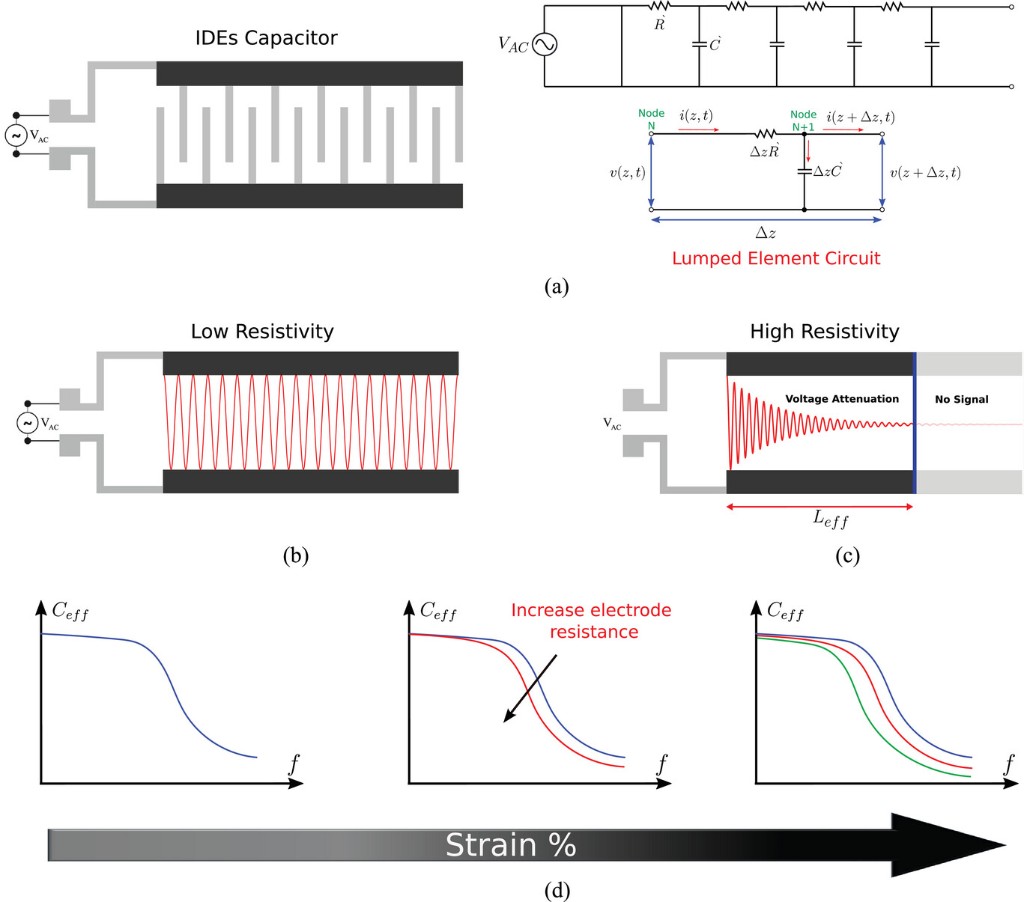
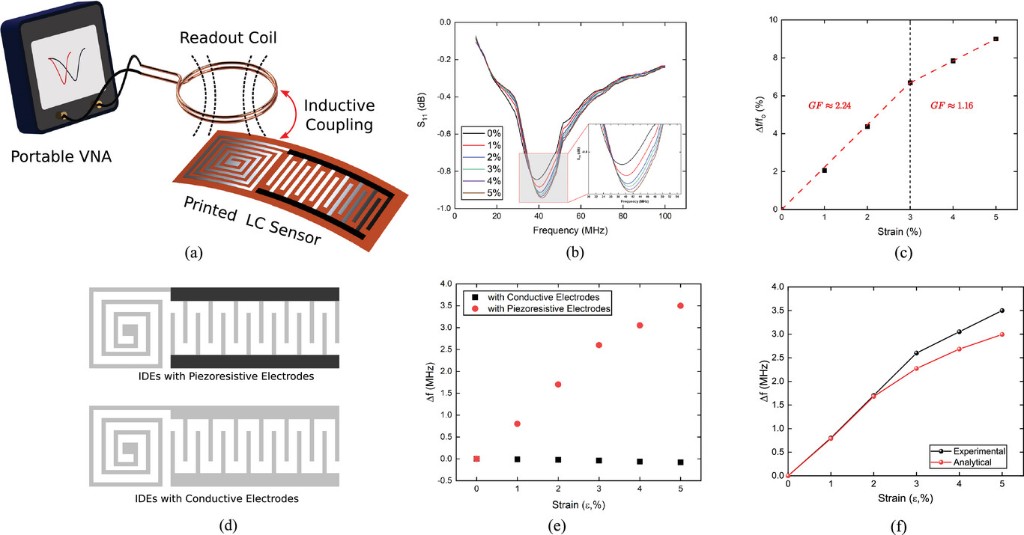
At the device level, interdigitated electrodes are modeled as a distributed RC network. Under low resistivity the AC signal spans the full electrode length; as strain raises electrode resistance, voltage attenuates along the fingers and the effective sensing length shrinks. That mechanism appears experimentally as a strong, frequency-dependent shift in effective capacitance and, in wireless LC tags, as a clear resonance-frequency shift under near-field readout—unlike control devices built with only conductive electrodes.
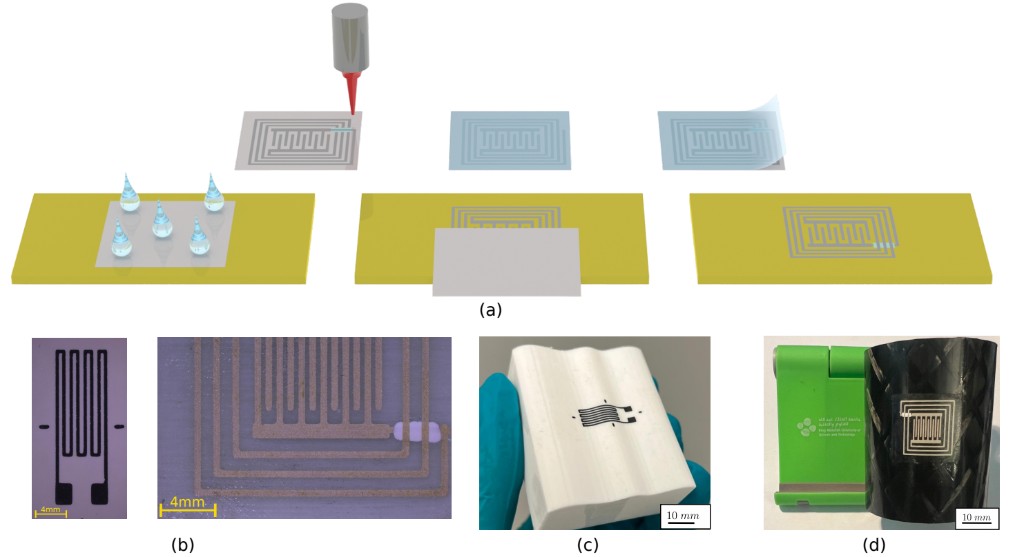
Building on this principle, fully printable sensors enable highly sensitive wireless near-field interrogation, while e-tattoo variants are fabricated as ultra-thin, transferable films that conform to textured and curved composite surfaces. Frequency-modulated printed capacitive sensing further improves sensitivity and linearity. The devices have been integrated with flexible wireless readout electronics for real-time SHM demonstrations, and the printable-sensor work received the Best Poster Award at LOPEC 2024.
Highlights
- Piezoresistive IDE electrodes that convert strain into a distributed RC / frequency-response change
- Fully printable LC wireless strain sensors with sensitive near-field resonance readout
- Ultra-thin e-tattoo formats transferable onto textured and curved composites
- Frequency-modulated printed capacitive sensing for higher sensitivity and linearity
- Flexible wireless readout demonstrated for real-time SHM
- Best Poster Award, LOPEC 2024
Videos
- Fabrication and Transfer Process for E-Tattoo Sensors
- Real-time SHM with Flexible Printed Sensors and IoT Circuits
Figures
Related publications
- A Fully Printable Strain Sensor Enabling Highly-Sensitive Wireless Near-Field Interrogation
- Integrated Piezoresistivity and Frequency Modulation for High Sensitivity Printed Capacitive Strain Sensing
- Integrable E-Tattoo Wireless Sensors for In-Situ Health Monitoring of Composite Structures
Awards
- Best Poster Award, LOPEC 2024