Wearable and Human–Machine Interface Sensing
Overview
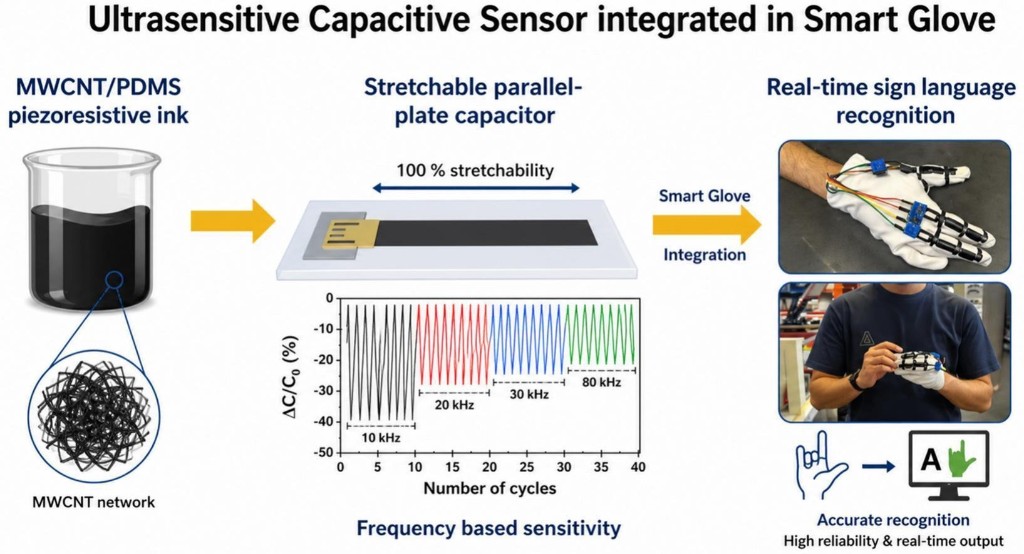
This project develops ultrasensitive stretchable capacitive sensors based on PDMS/MWCNT nanocomposite piezoresistive electrodes for wearable human–machine interfaces.
The sensors are fabricated as stretchable parallel-plate capacitors that retain electromechanical performance up to 100% stretchability. Their capacitive response is frequency tunable, enabling sensitivity to be adjusted through the interrogation frequency.
When integrated into a smart glove, the sensors support accurate, reliable, and real-time sign language recognition by mapping finger motion to digital gesture output. The work was developed in collaboration with BrightSign Gloves (UK) and reported in Materials & Design (2026).
Highlights
- PDMS/MWCNT piezoresistive ink for stretchable capacitive sensing
- Frequency-tunable sensitivity for piezocapacitive readout
- Smart-glove integration for real-time sign language recognition
Videos
- Smart Glove Sign Language Recognition Demo
Collaborator
Related publications
- Frequency-Tunable Piezocapacitive PDMS/MWCNT Nanocomposite Stretchable Sensors for Sign Language Recognition